
| University | Auckland University of Technology (AUT) |
| Subject | ECON863 Economics and Quantitative Methods |
Case study 1: Egg Shortage in US (15 marks)
(5 marks allocated for each part)
Average price of Eggs in the US have increased significantly from US $ 2.07 per dozen to US $ 3.37 per dozen over October 2023-2024. The following video link below explains in detail the reasons behind the same.
Reasons why Egg prices are higher in US
Based on the above case and information provided in the video, answer the following questions:
- What are the key non-price determinants of demand leading to this price increase of eggs? Explain your answer based on the analysis presented in the video.
- What are the key non-price determinants of supply leading to this price increase of eggs? Explain your answer based on the analysis presented in the video.
- An analyst argues that due to the combined impact of the demand-supply shifts as analyzed in the case video, the equilibrium price increase impact on consumers will be lesser. Would you agree or disagree with this argument? Explain your answer using an appropriately labelled diagram of the buyer seller interactions in this market.
Case Study 2: Retail fuel prices and Public transport in Auckland (15 marks)
(5 marks allocated for each part)
Refer to the graphic below:
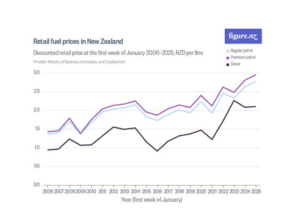
It shows that New Zealand has experienced significant fluctuations in petrol prices over the past five years year. Assume you are a business analyst for Auckland Transport (AT) and have been asked to submit a report on how these fluctuating fuel prices will impact on public transport planning in Auckland.
Stuck! Do not Know Assessment Answers?
Hire NZ Native Experts 24/7.
Answer the following questions as part of your response to the report:
- How can price elasticity of demand explain why such price fluctuations will impact public transport in Auckland city? Distinguish between short-run and long-run impacts, focusing on how AT’s revenue maybe impacted with a price increase.
- Explain, with examples, at least two factors that might influence the elasticity of demand for petrol in Auckland.
- Based on your answers in a) and b) suggest two policy recommendations for Auckland transport that can help them manage traffic congestion over the longer term.
News reference, reports can be used to substantiate answer
Case study 3: A Dairy farmer in Northland (10 marks)
(5 marks allocated for each part)
A dairy farmer in the Northland region owns a 200-hectare farm. The farmer could rent the land to another farmer for $1,000 per hectare per year. Their annual milk revenue is $1,200,000. feed, fertilizer, labor, and equipment maintenance costs are estimated to be $900,000. The farmer’s own labor is valued at $100,000, which is what they could earn working as a farm manager elsewhere.
- Calculate the accounting profit and the economic profit of the dairy farm. Why do they differ? Briefly explain your answer.
- Based on your answer to a) above, should you recommend this farmer to rent his land and work as a manager elsewhere? Justify your answer based on an economic rationale.
Case study 4: NZ mobile and internet service providers: Should consumers switch frequently? (10 marks)
A recent analysis by the Commerce Commission suggests that NZ consumers may not always be getting the best deals on their mobile phones, and that the market structure is such that more can be done to improve the pricing and affordability for consumers.
On the basis of the information provided in the link above and the analysis, answer the following questions:
- Assuming you are a business analyst, evaluate the pricing strategies of One NZ and Spark NZ and explain how they maximize profits. Explain your answer applying the characteristics of the underlying market structure and data provided in this article. (3 marks)
- Using and appropriate example with a suitable reference, analyze how mutual interdependence and rivalry might play out between One NZ and Spark NZ while considering adoption of new technologies, such as 5G and AI. (3 marks)
- Explain with some examples, how non-price competition might encourage price discrimination in this market. Briefly explain your answer using a suitable reference. (4 marks)
Buy Custom Assignment & Homework Solutions
Pay to NZ Native Writers | Cheap Cost & Plag Free
Are you stuck with your Microeconomics Assignment Report? Be stress-free! AI-free assignment help NZ is here for you. We assure you that our report-writing service will make you productive and help you achieve high grades in your academic year. A free list of assignment samples written by PhD experts is also provided here that can help you boost your study power and check the quality of the report. So contact us today and get your high-quality assignment!
Shared with


- ENCE5214 Cadastral Surveying Assessment 4 Portfolio: CSR 2021 Rules, 12d Traverse Case Study and Title Terms | Unitec
- DBC503.1 Business Communication Assessment: Communication Strategies, Implementation Plan and Stakeholder Presentation | Cornerstone Education
- MKTG903 Global Marketing – Future Dynamics Assignment 2: E-Business Case Analysis of a New Zealand Company | AIS
- MGMT902 Enterprise and Information Systems Assignment 3: Agentic AI Change Management Report for an NZX-Listed Company | AIS
- BBIS 5101 Introduction to Object Oriented Programming Assignment 3: C# Windows Forms Campus Facilities Issue Register
- STE404 Foundations of Sterilising Practice Assessment 2 2026: Microbial Resistance, Spaulding Classification and Tikanga Māori | Open Polytechnic
- STE404 Foundations of Sterilising Practice Assessment 1 2026: Hand Hygiene, PPE and Breaking the Chain of Infection | Open Polytechnic
- BBIM708 Machine Learning and AI Assessment 2 Portfolio 2026: Supervised and Unsupervised Algorithms, Grid Search, Random Search and K-Fold Cross-Validation | NZSE
- MHSC8.002 Health and Wellness in Aotearoa Assessment 2: Impact of Colonisation on Health, Māori Health Outcomes and Te Tiriti o Waitangi | EIT
- BBIM601 Business Intelligence Assessment 2 Project 2026: RetailCo BI Application, Hotel Booking and Cardiovascular Disease Reports | NZSE